Showing posts with label clouds and parhelia. Show all posts

Saturday, March 12, 2022

Circum-zenithal arc in Taurus from a 5-day crescent moon

This is one my most unusual images. I caught a circum-zenithal arc while taking a picture of the constellation Taurus:
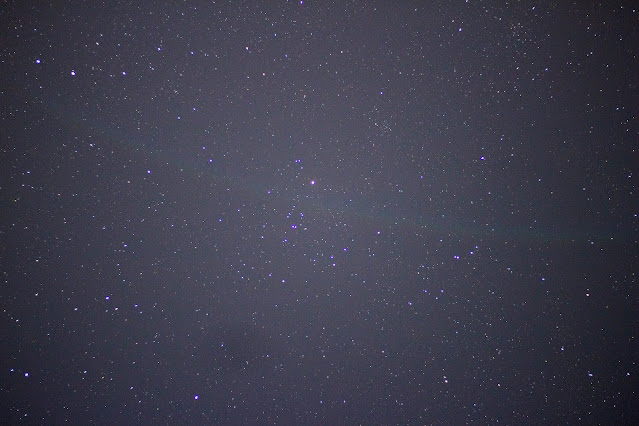

This image was taken with a 50 mm lens, which has a field of view barely able to fit the arc.

For comparison, here is a circum-zenithal arc in front of my home:
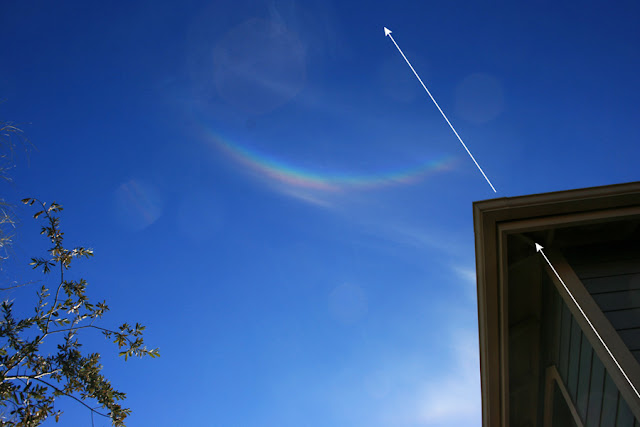

Until my Taurus arc, all images of circum-zenithal arcs I've seen are in daylight with the sun as the light source.  I included my house when I took the photo so I could use it to identify the zenith.

Here's my attempt to position Taurus in the same setting:
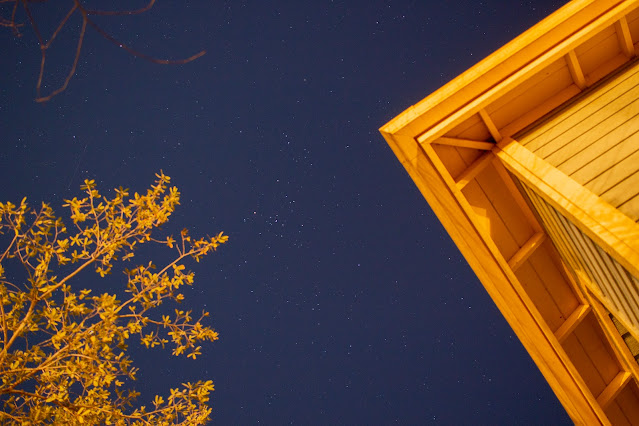
This photo was taken a week after the arc and I wasn't diligent about the time, but I hope it shows that Taurus is well-positioned to host a circum-zenithal arc at dusk in early February.


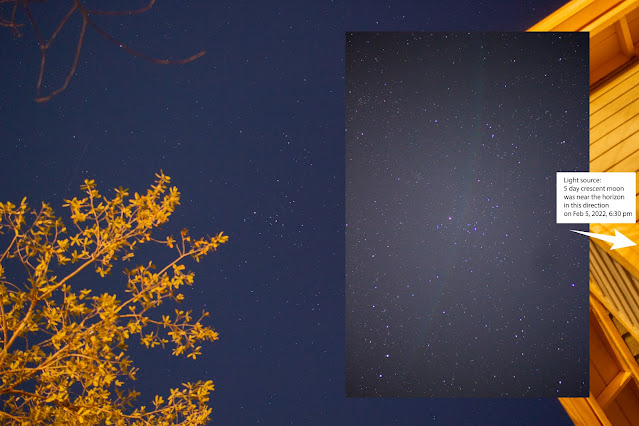
Here, I rotated the arc photo to match the orientation of my wide-field Taurus image. The arrow shows the direction of the 5 day crescent moon that was present at the time I took the photo.
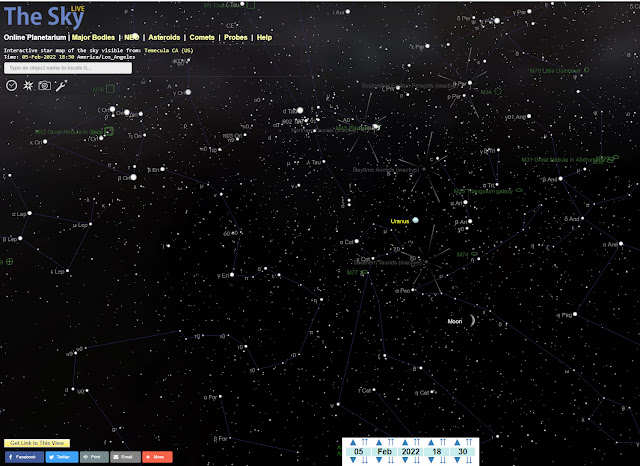
For additional verification that this is a circum-zenithal arc, and not the more common 22-degree halo, here is a view of my location and time when I took the image:


jg

Wednesday, May 22, 2019

Arcs narrow and wide

May 15 gave us spectacular displays of the 22 degree and 44 degree ice halos. Most remarkable, in my opinion, was that these unusually intense arcs were seen over a wide area. I had friends report seeing this affect though being nearly 20 miles apart at the time.

jg


Friday, July 21, 2017

Best ever circumzenithal arc,...

Best ever circum-zenithal arc and my worst camera met on the early evening of July 19, 2017. I drove to Riverside, and on the way, I became interested in the clouds and dispersal of a contrail. It looked like the conditions were right for hole punch clouds. I couldn't take any pictures, because I was driving.

Two hours later I emerged from a building and the sky over head smiled with the brightest and most long lasting arc I'd ever seen. I took numerous pictures with my aim-and-shoot camera and my iPhone. Neither of these devices captures the full color range of bright cloud effects.


jg

Friday, July 8, 2016

My best photos continue to be accidents

In March 2016 I was photographing the constellation Orion and got this:


Obviously, the camera moved during the photo, its movement is hard to create. The movement was fast at first, creating thin, faint streaks, and then slowed creating ever thicker and finally stopped points. The motion was caused my the clutch on my camera mount slipping, but the slipping action was sudden followed by increasing braking. I'm not sure how to get my mount to slip and brake like this again for other photos, but I think cold weather will play apart.

Another accident from this trip is catching the morning sunrise through a stunning orographic cloud:


"Klaatu Barada Nikto," as they would say in The Day the Earth Stood Still.


And of course, catching meteors are always accidents. This one is from April 8:


jg

Thursday, July 7, 2016

Circum-horizon Arc

On April 8, 2016 a nice circum-horizon arc appeared. I had seen a similar arc a month earlier, but only had my cell phone to photograph it. I tried a photograph with my phone but couldn't see the arc in the picture, so I took off my glasses to get a closer look at the image.  I was wearing a set of polarized clip-on sunglasses over my corrective lenses and realized that when removed, I couldn't see the arc in the sky either.  I put the sunglasses back on, and there was the arc again. Next, I tried photographing the arc through my sunglasses. The polarized photos were noticeably better at capturing the perceived color. So when I saw a much brighter arc, one that was visible without polarized sunglasses, I took photos with my Canon digital rebel camera with and without my sunglasses over the lens.

Circum-horizon arc with polarizing sunglasses over the lens

Circum-horizon arc using the camera's kit lens as is.

A more professional photographer would probably buy polarizing filters for all his lenses.

jg

Fog bow

I saw fog bow on May 16, 2016. A fog bow is the same effect as a rainbow but the sunlight is being refracted by fog droplets instead of rain. The result is a bow that is white but of the same angular size as a rainbow.


This fog bow sighting followed a night of star gazing at Palomar Observatory Campground, the first Explore the Stars event for 2016:

Meteor in Delphinius


Milky Way in late spring


jg

Sunday, November 22, 2015

Moon dog

On Oct. 24th, 2015, I saw my second ever moon dog. A moon dog is the same phenomenon as a sun dog but the light source is the moon instead of the sun. Moon dogs are more rare than sun dogs:

  • The moon is dimmer, so the effect is less noticeable.
  • At least half the time, the moon is in a phase that is less than half full, so it provides too little light to observe the prism effect
In the following photos, the moon is on the right and is over-exposed. The moon dog is the splash of light and color near the tree. Also visible in the pictures is the 22-degree ice halo that is commonly seen around the sun and moon:


jg

Sunday, February 22, 2015

Hole punch clouds

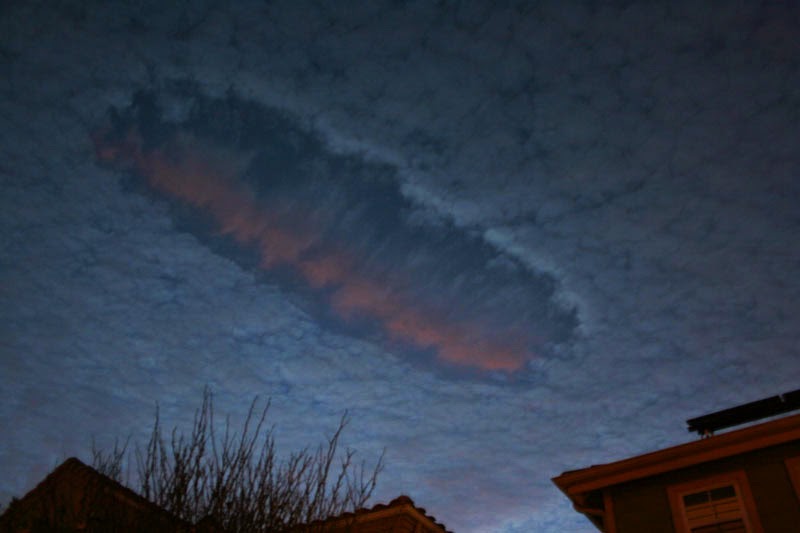
Shortly after sunset on Feb. 19 I saw what looked like a hole-punch cloud, also called a fall streak hole. It looked a bit like a giant space amoeba from Star Trek:


OK. Maybe a lot like one.

I understand these are caused by a domino-like effect where super-cooled water vapor needs a nudge to create a cascading condensation that then falls out of the cloud. One possibility for the source of the nudge is a passing airplane.
I've seen these before and I assumed updrafts from our nearby mountains were the cause, but I don't know.
At least one of my pictures confirms the hole punch occurred near the flight path of planes. The bright line in this photo is a plane:

However, my pet theory that the mountains are creating updrafts that trigger the condensation suggests that there would be more hole punches to coincide with the few peaks in the area, as shown in this photo from a couple years earlier:
Hole punch clouds above the mountains on my western horizon


I looked around for others and did find one, though it was less impressive:


Though less impressive, it did look a little like a giant rabbit in the sky (on its back), something I've been seeing a bit of recently and shared with the Orange County Astronomers last week:

Multiple hole punches does not eliminate planes as the source, so the cause in my region is not settled.

As the hole punch drift east, the sky was dark enough to bring out a few stars: 


Other hole punch clouds:


jg

Thursday, December 25, 2014

Iridescent clouds and crazy contrails

December 24 had some interesting clouds that produced great iridescence. My hand is blocking the sun in the picture below.


Iridescent clouds, 24 December 2014, ~12:00

The color in these photos matches that perceptible to the eye, though the sky is darker in my photos due to my camera's adapting to the brightness. Our eye can detect the colors of the sky and iridescence, but the camera, at least mine, has to choose one. If I had taken identical photos using different exposure times, I could combine the the images in Photoshop to reproduce the full range of color; but the iridescence was fleeting, leaving no time for tripod mounting or controlled exposures. My best results came from using the camera's automatic landscape settings.

Minutes after the above photos, a jet passed through the cloud, leaving a contrail up to the cloud but erasing the where it flew through. The erased parts are probably the hole-punch effect, where a plane or strong updraft punches holes in a cloud. This tells me that the cloud was very thin, perhaps a requirement for producing the iridescence. As the clouds thickened in the afternoon, the iridescence was gone.


Condensation trail with hole punch effect

jg


Wednesday, December 10, 2014

Sun Pillar in Wildomar's Western Sky


Monday was another parhelia day. I saw a sundog in the morning and pulled over to take a quick picture. Upon examining the photos, I learned that my camera's landscape setting had overexposed and lost the color. A lesson I applied later in the day.

When driving home that evening, I saw a sun pillar. Based on the morning's experiment, I knew I had to not just pullover, but pull off the road where I could take my time with manual exposure settings to get the sun pillar:


The sun pillar is the column of light in the center, caused by the downward refraction of sunlight by ice crystals in the atmosphere. Light from the sun that would normally pass over my head is being bent downward so I see it as a column. I suspect the geometry refraction through ice crystals limits how high the pillar can be.

The phenomenon lasted for about 5 minutes, making timing critical.

jg

Friday, April 4, 2014

Tangential Arc

Last night while conducting an astronomy program, I saw a tangential arc. I was caught without a good camera and this cell phone photo failed to catch the full color of the 5-minute phenomenon. Also visible to my eye, but not well shown in this photo, was the 22-degree halo around the setting sun.


This is the second tangential arc I've seen. The last one was on Dec 2010 and was accompanied by a very faint circumzenithal arc:

jg

Friday, March 21, 2014

Sucker for Sundogs

Good atmospheric effects like company. When I see the clouds favorable to sundogs, sun pillars, arcs in the morning, the remainder of the day and into the evening often offer similar effects. This isn't surprising because the effects are caused by weather and a specific type of weather conducive to these effects may last more than a day. 

On March 5, 2014, I noticed sun arcs at noon:

Sun arc taken at 28 mm focal length

Sun arc zoomed in (70 mm focal length)

That evening I watched for more effects as I drove home. I was travelling, or else I would have tried to capture the unusual clouds to the west. At the same time, two friends from the Temecula Valley Astronomers were watching, one from Temecula, the other from Anza. Each had a better view that what I had. Here is what they saw:

Sun pillar by Harry Finch

Based on the photo, this was an impressive sun pillar (which is caused by ice crystals refracting the sun light in such a way that the light is spread out vertically).

A similar pattern occurred yesterday: interesting cloud effects in the morning, and good sundogs at evening:
Contrails on the morning of March 20

Right sundog on evening of March 20

Left sundog on evening of March 20

Both sundogs with the sun blocked by the tree

If you see something interesting in the morning, it's a reminder to get your camera and keep it with you for the day. 

jg


Tuesday, September 3, 2013

Circum-Horizon Arc at Joshua Tree

On labor day, 2013, I used my magic for finding locations that I nearly have to myself. My secret this time was to choose desert-baked rocks at Joshua Tree National Park during high temperatures coupled with unusually high humidity. Though the humidity was challenging my personal breaking point, it came with the blessing of great and rare cloud formations. Most notable was a circum-horizon arc that caught me without a camera, so I had to use my cell phone:

Circum-horizon arc in the sky showing green to orange rainbow colors.
 
In the photo above, I imagine the cloud in the lower right as an obscene gesture taunting me for not having my best camera.

A half hour later, maybe longer, I had my camera and had finished climbing another outcrop of rocks. When I looked back to admire my progress, the arc had returned, now sporting a lot of blue and green color:

 
Over the next 10 minutes, the arc changed to emphasize the orange part of the rainbow spectrum:


This photo is an attempt to provide a reference point for the location of circum-horizon arcs. The sun is just off the top of the photo, and around it is the more common ice halo that was also visible this day. The circum-horizon arc can be seen in the lower right.


I understand that circum-horizon arcs can be seen only when the sun is high overhead, making this effect a summer phenomenon. That is, I assume at my lattitude (about 32 degress N.) the sun never gets high enough in winter (though the atmospheric conditions are more likely to produce the necessary ice crystals to create this refracted light effect). High summer humidity and thunderstorms, however, puts a lot of moisture high enough where it can freeze and give us these arcs. This is the second circum-horizon arc I've seen. The last one was in early Aug. a couple years ago.

jg