Showing posts with label animals. Show all posts

Tuesday, May 26, 2015

Rattling a Snake

When I climb through places that could harbor a rattlesnake, I make loud claps to improve the chance that a rattlesnake might hear me and start moving away, or start rattling. Yesterday I had the opportunity to test this method. I encountered a dozing rattlesnake, so I recorded before and after making a loud clap to wake it. The loud clap didn't disturb it in the slightest. I conclude that one shouldn't be confident that making noise will help avoid a rattlesnake encounter.


I will add that most of my snake encounters fall into two categories: One, like this one, where the snake makes no motion or sound, and two, where the snake quickly hides and rattles. These responses appear to have more to do with the mood of the snake than with anything proactive that I can do.

jg

Update: A closeup, as the video didn't capture the snake clearly:

Tuesday, July 22, 2014

Illustrations for Seal of Approval, a Article about Bio-Logging

I've had the pleasure of contributing a few more illustrations to an article on Skeptical Science. I've shared the illustrations here, but recommend the article: Seal of Approval: How Marine Mammals Provide Important Climate Data.

A summary of advances in the use of animals to carry sensors.

A summary of the data collection cycle of an ARGO ocean sensor.


A summary of the how seals contributed to our understanding of the collapse 
of an Antarctic ice shelf.

jg

Saturday, June 14, 2014

When looking up, don't forget to look down

A keen-eyed observer at the May 31 Explore the Stars noticed a glow on the sidewalk that turned out to be a caterpillar with a bio-luminescent belly. I tried to take photos, but getting a good focus in the dark was difficult. Still, I got close.

This close up captures the color of it's glow. I think this was a 5-10 second exposure.


Curious observers soon arrived and examined the sight with their red flashlights, which lit up the scene. 

I quickly realized that some context was essential to the photograph. The shadow of my tripod can be seen next to the glow.

A friend tells me that most likely it's parasites in the caterpillar that are creating the glow -- another subject to look up sometime.

jg

Monday, April 7, 2014

Rattlesnakes

I believe this spring will be a good year for rattlesnakes. I've already seen three, two in just this previous weekend. 

Rattler from 4/5/2014:


Rattler from March 20, 2014:


Rattler from 4/6/2014: 
(Better quality videos are here: rattlesnake1, rattlesnake2.)

Saturday, March 22, 2014

Newtidy

While scrambling through a canyon today, I saw a pair of newts mating, or so it seemed to one untrained in the ways of newts. I believe them to be the California Newt.


This reference places the California newt in my region: Identifying California Salamanders

jg

Monday, February 24, 2014

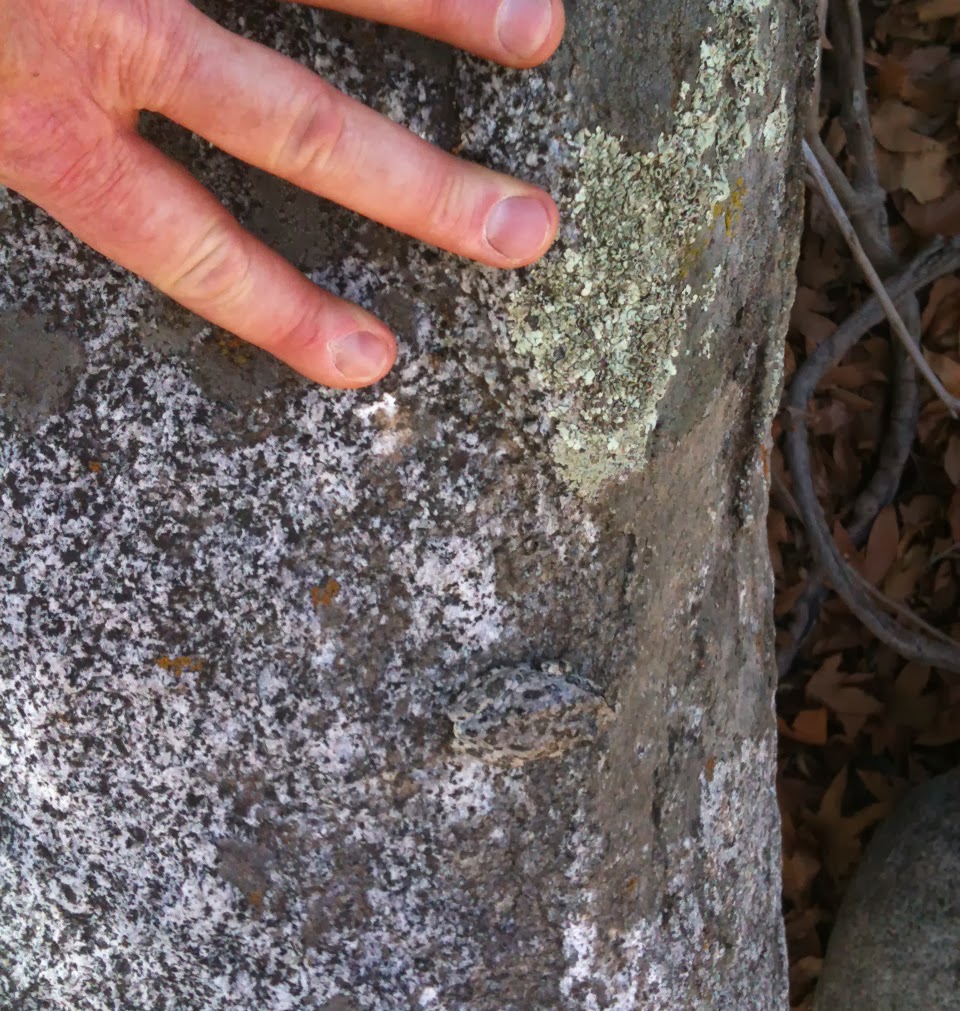
Frogs and Camouflage

I never tire of seeing a well-camouflaged creature, such as the frog or toad in these pictures. I almost flicked this rock off of my foothold, but stopped, realizing it was no rock. (How a rock had inserted itself onto a foothold I had used 15 minutes earlier hadn't occurred to me.) I admire not only how the frog/toad matches the granite, but also how half of it's back matches the dirt on the granite. Of course, after a vigorous day of rock climbing, I, too, often match the dirt.


jg

Wednesday, September 11, 2013

Message in a Bottle

Tiny actions we take affect other other creatures. I'm sure the person who discarded this bottle at a scenic location knew that when the glass breaks it would pose a safety hazard. This person probably knew that he or she was creating pointless litter in a scenic location that is enjoyed by many visitors. And the person probably knew, that eventually, someone would pick up the bottle. But I suspect the person did not know that before the bottle would be collected, it would trap and kill a couple dozen beetles.


I photographed the bottle because I found the number of dead beetles in it remarkable. I then shook out the contents before stowing it in my car, but as emptied it, I was surprised by how many dead beetles of all sizes continued to fall out. I regret that I didn't count them first, but I estimate two dozen beetles died in this bottle.

Thursday, March 14, 2013

Tis-tst-tst-ststst-sss-tstst the Season

With the onset of Spring out come the rattlesnakes. I photographed a baby rattler with my shoe for size. Snakes like these are why I never hike with my sunglasses on. For me, sunglasses make it harder to see a snake in the trail, especially if the trail is covered by shadow.

Baby rattler (I think it's a western diamondback)


A size twelve shoe shows how small this snake was.

jg

Friday, March 25, 2011

Hopping to admire the camouflage

"Hopping" is a pun on the title of my previous camouflage post (stopping to admire camouflage), and appropriate, as this time I'm celebrating a  frog (or toad -- identification pending). Here he is on a rock of granite that creates a natural pond referred to in my region as a tenaja.


The canyon I visit can be accessed by hopping from rock to rock -- no pun intended. Crawling through the banks puts you in tangles of underbrush which include poisen oak. Along with the camouflage of animals, I also admire the tenacity of plants that cling to the stream bed:

Above: a California sycamore with most of its root base exposed. The tree still lives, as it tendrils reach down into the bed. Notice the rock it's cradling (about mid center); I wonder how long the exposed roots have been holding this stone.


Above: a more complete view of the same tree.


Above: Another tree with an apparent tenuous hold on the bank.

Above: I believe this one to be a willow, quite thrashed by the winter rains (we have no snow melt here -- mediterranian climate -- most of our rain fall in the winter and spring months). It's leaves haven't sprouted yet. The green behind it is from a poisen oak.

Above: A velvet ant observed away from the stream.These are about the size of a honeybee and are definitely not camouflaged.


Above: one more look at the frog that inspired this post.

jg

Saturday, October 23, 2010

Stopping to admire the camouflage

You really have to admire the camouflage of these horned toad lizards:

Can you see the lizard?

Here's another photo with my shadow almost holding the lizard (almost, because I didn't want to scare it away):


And another view:


jg

Monday, September 13, 2010

Lizard on mirror

Amateur astronomy presents numerous surprises. In this case, a friend of mine was having trouble collimating his newtonian reflector. Astute problem solving quickly determined the cause:


This photo shows the view down the aperature of a rather high-end telescope he uses for imaging. The sacrosanct mirror is at the bottom of the tube, and the blurry foreground shows the telescope tube and secondary mirror.

The lizard appears to be a species we refer to as alligator lizard, for the pattern of the scales resembles an alligator's scales.

jg

Saturday, July 17, 2010

spider with a face

I find faces on insects to be quite creepy, and intriguing. Can you see the face on this one?
Photo taken on 7/16/2010, San Diego, CA

Thursday, June 10, 2010

Colors and Recovery, Lizards and Flowers

(Update 12 Jun 10: I've added plant identifications under each photo.)

Within the last three years, the region south of Palomar Observatory burned. This fire displaced many people for a few days and even jumped an eight-lane lane freeway. This year I noticed an abundance of a plant commonly called "deerweed", though I object to the "weed" part of its name.

Tuesday, April 20, 2010

Butterfly collection, part 2

More butterflies and moths photographed in Southern California on April 16 and 17, 2010:
Same species, inside and out, and also shown below.


Saturday, April 10, 2010

Butterflies


This isn't an abstract painting or Photoshop treatment; it's the blurred image of a swallowtail butterfly that wouldn't land. I can see why people used nets and toxins to capture these subjects. Nowadays, digital images are cheap and I could keep at it till I got a couple lucky shots:


My other subjects kindly landed long enough for me to get their pictures:

(These are all the same species; the blue is visible only when the wings are open)


(a moth?)


I regret I don't know the common or scientific names for these creatures, but posting these where I'll find them again is the first step. I'll add the names as I learn them.

I believe that this one, from two weeks earlier, is the Quino Checkerspot, a species that invites developers who find it on their real estate to partake in humanity's effort to protect the biological diversity of our planet. --a way of saying they are listed as endangered.


I'll verify the species type when I can.

jg

Saturday, August 22, 2009

Striped mystery beetle


I found this bug while I was raking leaves. I put him on a desert mallow for safe keeping. I have no idea what species this is.

jg

Update: Icesign adds this link: http://en.wikipedia.org/wiki/Colorado_potato_beetle

Friday, August 21, 2009

Color on the Web

Several years ago I killed the grass and put in a native plant garden. This garden continues to surprise me. In this case, it was the color transmitted through a dry spider web that amazed me. I emphasize that there was no moisture to create the irridescent effect. I hope the photos below show on your computer the colors I saw. Click the photos to see the colors better. I made no enhancements to the photos.


And last... no butterflies were harmed in the taking of this photo:


jg

Tuesday, July 7, 2009

My own menagerie

Here are some of the animal photos I've taken while on local hikes:


Grey Fox: I met his creature chasing a rabbit. (He was chasing the rabbit.) Both lept out of the bushes beside me and the rabbit disappeared. The fox looked at me (posing) and lurched off into the bushes.

This is known as a Jeruselum Cricket. The inset on the left shows my foot (men's size 12) next to the cricket for size. (This is as close I as got to the creature.)


I don't know which species this hummingbird is, but I think the red marking on the throat will be obvious to those who do know. I was impressed that I could unwrap my camera and get shot in time to catch its wings in motion.


When encountering a snake on the trail, I usually scare it away with my almost involuntary foot shuffling (a natural and beneficial panic reaction that I've never cured myself of), but this rosy boa stayed put. Though rosy boas are common in our region, seeing one is rare. Since seeing this boa obstructing the trail, I've contemplated what it would be like to see the boa from 58 million years ago reported in the journal Nature. The authors describe a boa that was a meter wide, that would be like a meter wide log laying across the path.


And... according to an interpreter at the ecological reserve (where all of these photos were taken), this above insect is Manroot Borer (Melittia gloriosa). They are found from Kansas and western Texas to southern California and up through Oregon. The caterpillar bores into the wild cucumber root (Manroot) and overwinters in a silken cocoon beneath the soil. It is highly prized by collectors. Probably for its attractiveness (note the species name) but also because it's rare. They are in flight during the months of May through October and they become more active as the temperature increases.

jg