Showing posts with label comets. Show all posts

Tuesday, July 21, 2020

Comet NEOWISE

These are likely my final images of Comet NEOWISE unless something astronomically interesting happens, such as fragmenting or an outburst.

These were taken in the California desert on July 19:

Comet NEOWISE, 28mm, f3.2, 105 seconds, iso 400


Comet NEOWISE, 380 mm, f5, iso 400, 180 seconds

The first photo has two people in it who I think were facing the wrong direction.


Update: I'm tracking the comet's fading:

Images of Comet NEOWISE taken with identical telescope and camera settings.
Height above the horizon varies and results in a change in the background.


jg

Friday, July 10, 2020

Comet NEOWISE 2020

A modestly bright comet has made it around the sun in one piece. These photos are from Southern California the morning of July 9, 2020.

Image taken through a 3-inch telescope at f5.

Image taken with a 50 mm lens.

jg

Sunday, September 16, 2018

Comet 21p tags M35

The morning of Sept 15, Comet 21p passed in front of open star cluster M35:

Comet 21p with M35. Image was processed to accentuate the green color.

Comet 21p with M35

My exposures spanned about 24 minutes. So, I put them together into an animated GIF to show the comets apparent motion over 24 minutes:

All photos were taken with a 3-inch refractor at F5. Exposure times and ISO settings varied, but my best results were with 1600 ISO at 30 seconds and 800 ISO at 60 seconds. Any longer, and I get too much light pollution. Still, I'm happy with what I can capture under my semi-urban sky.

jg

Monday, September 10, 2018

Meteors, comets and clusters

Comet 21P is visible in the morning sky. Over the past week it has moved through the constellation Auriga. Here are images taken with a 3" telescope and digital camera.

8 Sept. 2018, 30 seconds, 1600 iso, f5

10 Sept 2018, 21P near M37, ISO 3200, F5, 20 seconds.

Meteors remain one of my favorite targets, being that the equipment set up is simple, tracking errors are easily forgiven, and success is related to opportunity. I've seen meteors brighten, dim, and then brighten, but this is first I caught on camera:

Sagittarius with meteor. 28mm, F3, 60 seconds

jg

Sunday, April 2, 2017

Comet 41p Tose

Ok. "Tose" isn't the name of the comet, but if you take out the 41p, hopefully the joke is obvious.

The night of April 1, I took photos of 41p using a 3-inch telescope at f5. My camera's remote shutter release has failed, so all my photos had to be shorter than 30 seconds:


30 second exposure at 3200 ISO

After some trial and error, I decided 20-second exposures at ISO 3200 produced a series of frames worthy of stacking (combining).

Before stacking:


After stacking 7 images:


After playing around with image-enhancement features that I don't fully understand:

I also put together a video to shore some motion of the comet seen in the span of photos I took:


jg

Update: more photos from the weekend.


Friday, March 31, 2017

Cometose: Comet 41 P, April Fool's Comet

You may hear of Comet 41P making its closest pass to Earth on April Fools' day, 2017. This is true. The comet is real and moving from the Big Dipper to Draco, but it is very, very faint, or as I like to say, cometose.

Last night I got a whisper of 41P using a 28 mm camera lens and 30-second exposure. Here, I've shown its location near Ursa Major (Big Dipper):


The inset is the region with 3/30 and 3/31 but moved out from under the position labels. The full-resolution inset is here:

I doubt this comet will be visible to the naked eye. I also think it's not a good one for suburban skies, but regardless, I'll be looking again tonight, as there's a chance it will be brighter.

jg


Sunday, January 25, 2015

Entering the processing fray

The greatest advancement in astronomy is probably the computer, for amateurs and professionals alike. Stacking images is now routine procedure for images published by amateurs. I'm coming to this software angle rather late in the game. Here are my first attempts using Comet Lovejoy as my target and the free software Registax:

Single 3-minute image, no processing

Stack of 4 images

What a fabulous sinkhole for my time that has just opened up!

jg

Friday, January 9, 2015

Cold Fuzzies

The past two nights I was able to photograph Comet Lovejoy, despite the onsite of clouds and rain. The sky was more clear on Wedns. night, shown by the better color and contrast in the first photo.
However, I was surprised to see the last night, when photographing through clouds, the comet had a more noticeable tail. 


Also more noticeable is the slight drift or elongation of stars, caused by not having my camera mount accurately polar aligned. I couldn't see Polaris, so I had to guess at the alignment, and so the stars and comet show a little drift. I wonder if the drift motion, being at a right angle to the direction of the tail, helped enhance the tail.

jg


Tuesday, January 6, 2015

Lovejoy update


Comet Lovejoy on 6 Jan 2015. Tomorrow, the comet is predicted to be at its brightest, but tonight the sky was clear and clouds are in the forecast for tomorrow, so this may be as bright at it gets for me.


jg

Tuesday, December 30, 2014

Comet Lovejoy

On December 29 I observed comet Lovejoy using binoculars and a small telescope. It was very easy to see in a 9x50 finder scope, even with a bright moon. Here is a wide field view of the comet in relation to Orion. Lovejoy is in the crosshairs. Over the next week it will move approximately in the direction shown by the arrow.


Here is comet Lovejoy in a small telescope: 


The next best time to watch for this comet will be in the early evenings after January 7th, because the moon will be out of the way.

jg

Friday, August 29, 2014

Comet C/2014E2 (Jacques)

It's exciting to have comets visit us, as they exhibit a range of qualities, defy prediction, and if nothing else, change position from night to night.

I've been able to photograph Comet Jacques twice this week using a telescope. These photos are with a 3-inch telescope at focal ratio 6.3:


Comet Jacques, 26 August 2014 (The image has been
cropped and the exposure level manipulated in Photoshop)

Comet Jacques, 26 August 2014 (Image cropped)

I can see this comet through a 9x50 finder scope, but not in my 7x50 binoculars. Two reasons may explain this: the finder scope isn't being held, so doesn't wiggle, and though both instruments have the same light gathering power, the higher magnification of the finderscope improves the contrast so that there is less glow from the background.

UPDATE: I got a little more quality time and space on Aug 29 to add this:


Same camera, same scope, but better sky.

In this animation, I spliced images taken from 9:40 to 10:20 pm:


jg


Sunday, August 24, 2014

Comet Splicing

Last night I observed a comet passing through Cassiopeia. Here is a wide-field image with Cassiopeia rising on the right and the comet (a green smudge) almost dead center.


I was using a 28-105 mm zoom lens, so after centering the comet, I took images at maximum zoom:


The comet is just left of center and Cassiopeia's center star is at the right.


Here is an un-cropped wide-field image. Depending on how well this web media preserves the image size and quality, you may be able to click into the image and see the comet and the Andromeda galaxy.

When you think about it, the above image shows Earth, an object from our solar system, our galaxy, and a distant galaxy. 

Using the telephoto lens, you can also detect the comet's movement against the background stars. This animation joins three images taken between 9:40 and 11:05 pm:


The first two frames were taken at focal length 70 mm, and the last at 105 mm. I wasn't planning to capture an animation, so I failed to keep consistent camera settings throughout my session, but you can tell the comet's motion is not due to my inconsistency.

jg

Update: I've added a map showing where to look on Aug 25:


Saturday, June 14, 2014

Comet PANSTARRS 2012k1

I'm hopeful of seeing comet PANSTARRS 2012k1 this month. On May 31, I took 28 mm focal length exposures of the region between Ursa Major and Leo and was able to capture the greenish comet

Location of PANSTARRS 2012k1 
on 31 May 2014 relative to Ursa Major.


In this photo, PANSTARRS is in the smaller circle:

My experience suggests that if I can capture a comet in a wide-field photo, I can see it in a medium sized telescopes and possibly in binoculars. However, dark observing conditions will be necessary.

Here is a close-up of the larger circle. the object in the middle has a green hue, common with comets:


Using the Heavens Above website, I created a map showing where to expect the comet on the weekends of June 21 and June 28: 


jg

UPDATE: I labeled the magnitudes of stars for estimating brightness. PANSTARRS is dimmer but more diffuse than a nearby 9th magnitude star.


Friday, October 18, 2013

Comet Hunt for October

Comet ISON is in the morning sky, but I haven't seen it. I took some photos of the region this week. In the photo below, ISON is supposed to be a coupled degrees distant from Mars and Regulus (the two bright stars in the picture):

I scrutinized the picture, but can find no sign of a comet, suggesting that viewing the comet needs a telescope, which can improve the contrast between it and the glow of my light polluted sky. Perhaps a longer exposure under a darker sky would reveal the comet. My photos were taken on the morning of Oct 16. By now, the full moon interferes, so the next prime opportunity to search will be in about 9 days.

Meanwhile, the morning sky enabled my first photo of the southern star Canopus, which is the second brightest star in the sky. Here is Canis Major, with canopus on the horizon (just right of the tree).


This  is the same area, but a little longer exposure. The stars and star clusters in Canis Major are easier to see, but Canopus is not as bright because it hadn't yet cleared the tree:


Sirius is the brightest star in the night sky, and the brightest in Canis Major. Canopus is the second brightest star in the night sky. It is rare for northern hemisphere observers to see both. 

jg

Thursday, March 14, 2013

Comet PANSTARRS

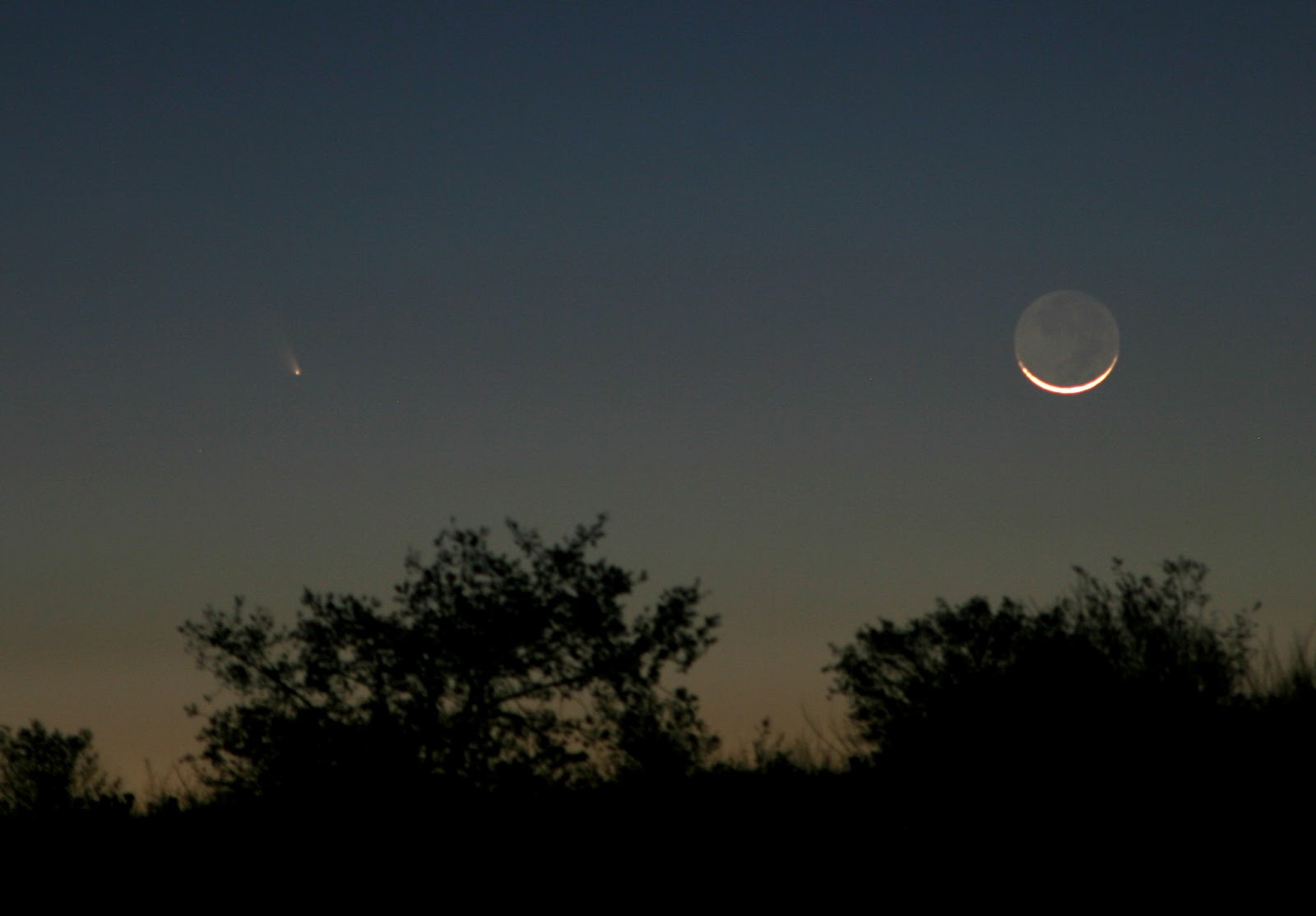
I'm posting more images from my 3/12 photo session with the lovely comet PANSTARRS. All photos were taken with a 28-105 mm camera lens at f4. I used a variety of zoom settings and I believe all exposures were between 1 and 8 seconds, as permitted by the brightness of the sunset's glow. The first image shows the setting with crepuscular rays so one can envision where the comet was in relation to the setting sun. By now, it has moved north of the setting sun, where it should be visible tonight. (Double-click to enlarge the images).
jg