Sunday, January 7, 2024

Big Bad Wolf

Yesterday, my son and I returned to Red Rocks Canyon, NV to conquer the 4-pitch route called "Big Bad Wolf". I may also have conquered my big wall, multi-pitch anxiety. He wanted to lead his first 4-pitch route and I wanted mostly to not hold him back. 

Pitches 1-3 of Big Bad Wolf, Red Rocks Canyon, NV

The total distance vertically is 250 feet and my son described it as his most challenging lead climb yet. The first pitch is rated 5.9 (I'd done two 5.8s at Red Rocks the previous week). Pitches 2 and 3 are 5.8; and pitch 4 a 5.0. In free climbing, you use the equipment to catch a fall and not to assist your ascent. I'm guilty of grabbing one anchor that I was trying to remove, so technically, I did not complete the route as a pure free climb, but I think any 61-and-a-half-year-old trying to keep up with an 18-year-old Gumby is allowed to pre-empt one fall. In fairness to myself, I might succeed on a second try, because I'd know the route and use less energy getting to the crux, and then have more strength to work out the necessary maneuver. 

This photo shows the entire first pitch with my son out of sight at the top setting up the anchor to support my climb. It is these moments when he sets up the anchor that I have a little down time and can take pictures.

Pitch 1 waiting for me to follow the lead.

3rd is a shot over my shoulder at the first belay station. There's a large flake that is the crest that obscures most of the first pitch. Just behind the flake you see our distant water bottles at the base of the climb.

The view over my shoulder at belay station 1

After pitch 2, I took a selfie. Pitch 2 is more of a slab, but there was a point where I thought I would fall. My son said I let out a "power yell" but according to him, I didn't put weight on the rope. I didn't grab any anchors either, so it was a clean free climb.

Selfie at belay station 2

After my son finished pitch 3, I snapped a few pictures of the jagged wall to the left and scenic vista to the right. I also saw a fragment of desert varnish that looked like a horse. Still, I did not look down. (All my down shots while on the wall were taken blindly over my shoulder.)

View left of belay station 2

View right of belay station 2

Desert varnish at belay station 2, looking like a horse

Pitch 3 was the most enjoyable in that it started with a confidence building slab that reduced the feeling of being exposed to open air and ended with a wall that required some enjoyable effort and strategy. While my son setup the 4th belay, we were visited by bird -- a nice reminder of where we were, and a reminder to enjoy the moment. I started looking down.

Belay station 3, view left

A bird visiting me at belay station 3

Same bird

View right at belay station 3

Pitch 4 was an easy 30-foot scramble, but after the previous pitches and the January cold, our legs suffering the "sewing machine leg" effect, it's best to go through all the motions: set up anchor, belay the first climber, place gear, and setup the last anchor, and follow safely to the top. 

View from the top of pitch 4

The leader collecting the rope for the descent


While I've compared the joy of a well executed climbing move to a flying dream, I'd compare climbing a multi-pitch route to the closest any of us will get to going to the moon. Once you start, you can't bail out quickly. It's safe but you have to go through all the best practices, the equipment check, the careful setups at each belay station, the standard communication commands, the focus, the safety checks, taking turns, and repeat. Doing this, we covered 250 feet in about 3-4 hours. It was maybe a half hour scramble to get down, plus time for pictures.

Ghostly erosion on the walk-off descent

More ghostlies on the walk-off

jg (Jan. 5, 2024)


Friday, July 8, 2022

Tau Herculid Meteor Storm, May 30, 2022

While I can't confirm that the Tau Herculid meteor storm delivered as a storm, I think it qualified as a shower, and as good as any I've seen or probably will see from my backyard balcony since the LED lighting revolution.

The meteors were notably slow and dim. Since I was pointing my camera near the radiant (apparent origin in the sky), the trails appear short because I'm looking at their paths head on. I also over saturated the color in the meteor images. The colors in the meteors, and the changes of color, confirm that these are burning light sources rather than reflected light sources from satellites. (I'm seeing more and more stock meteor photos that really are satellites, not meteors.)


Tuesday, May 17, 2022

Lunar Eclipse, 15 May 2022

 After reviewing a hundred nearly identical images I took during the May 15 lunar eclipse, I decided none cleaned up better than this 5-second exposure:


This image was taken with a 3-inch APO refractor at F5, 100 ISO and cropped to 1920x1280 pixels. The mount is a Losmandy G-11 and I used its lunar tracking rate. I believe the tracking rate made a difference in quality of fine detail, because I see motion blur in the background stars that is consistent across many images. If not for the lunar tracking rate, the motion blur would be in the moon image. The motion blur of the stars is detectable in my 5-second exposure but obvious in this 15-second exposure:


I've been seeing a number of eclipse composites, where the images of the entire eclipse event are superimposed on a scene. Most bother me, for the scale looks wrong. I prefer that composites be an honest depiction of scale and motion, or contain a caveat.

Here's the eclipse with a 28mm lens.


This shows the size of the moon against the roof line of a two story house about 60 feet away. 

A half hour earlier, the moon was in the trees:


The distance the moon travels between my wide-field images and it's apparent size are hard to squeeze into these composites from other sources: 


jg


Saturday, March 12, 2022

Circum-zenithal arc in Taurus from a 5-day crescent moon

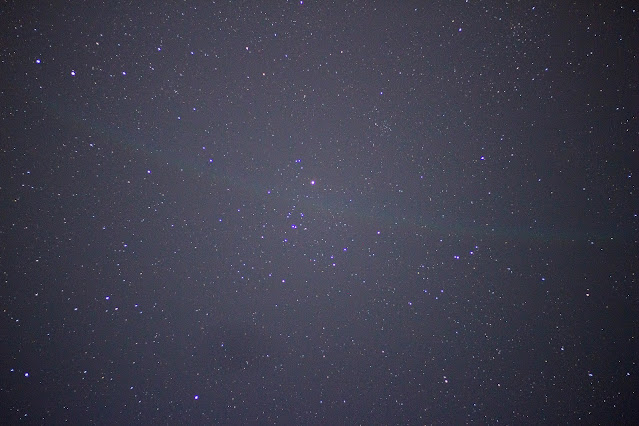
This is one my most unusual images. I caught a circum-zenithal arc while taking a picture of the constellation Taurus:


This image was taken with a 50 mm lens, which has a field of view barely able to fit the arc.

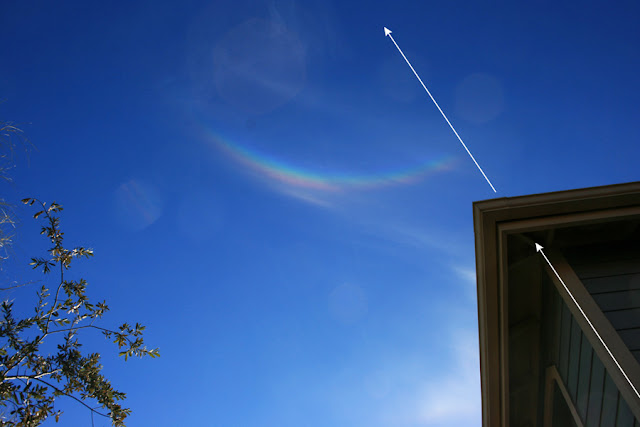
For comparison, here is a circum-zenithal arc in front of my home:


Until my Taurus arc, all images of circum-zenithal arcs I've seen are in daylight with the sun as the light source.  I included my house when I took the photo so I could use it to identify the zenith.

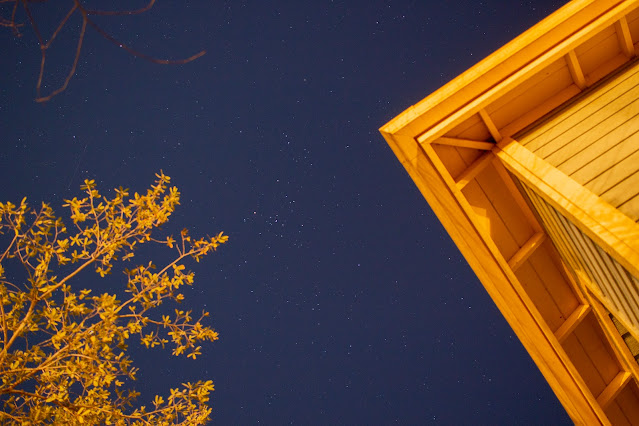
Here's my attempt to position Taurus in the same setting:

This photo was taken a week after the arc and I wasn't diligent about the time, but I hope it shows that Taurus is well-positioned to host a circum-zenithal arc at dusk in early February.


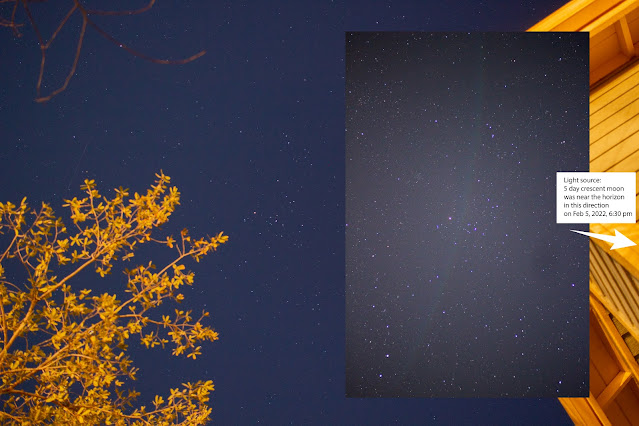
Here, I rotated the arc photo to match the orientation of my wide-field Taurus image. The arrow shows the direction of the 5 day crescent moon that was present at the time I took the photo.

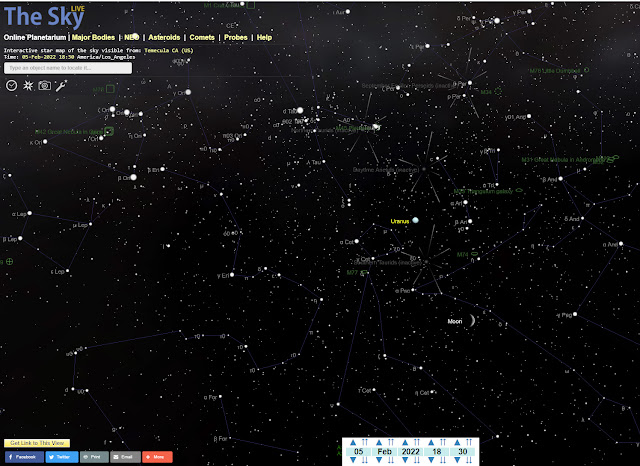
For additional verification that this is a circum-zenithal arc, and not the more common 22-degree halo, here is a view of my location and time when I took the image:


jg

Tuesday, July 21, 2020

Comet NEOWISE

These are likely my final images of Comet NEOWISE unless something astronomically interesting happens, such as fragmenting or an outburst.

These were taken in the California desert on July 19:

Comet NEOWISE, 28mm, f3.2, 105 seconds, iso 400


Comet NEOWISE, 380 mm, f5, iso 400, 180 seconds

The first photo has two people in it who I think were facing the wrong direction.


Update: I'm tracking the comet's fading:

Images of Comet NEOWISE taken with identical telescope and camera settings.
Height above the horizon varies and results in a change in the background.


jg

Friday, July 10, 2020

Comet NEOWISE 2020

A modestly bright comet has made it around the sun in one piece. These photos are from Southern California the morning of July 9, 2020.

Image taken through a 3-inch telescope at f5.

Image taken with a 50 mm lens.

jg

Wednesday, May 22, 2019

Arcs narrow and wide

May 15 gave us spectacular displays of the 22 degree and 44 degree ice halos. Most remarkable, in my opinion, was that these unusually intense arcs were seen over a wide area. I had friends report seeing this affect though being nearly 20 miles apart at the time.

jg


Sunday, January 20, 2019

Lunar Eclipse, Jan 21, 2019

Here are some photos from tonight. I took over a hundred, and picked out a few that look typical. I hope to take a closer look in the next couple days.

jg


Renewable LEAPS of Faith

12 years ago I opposed a local pumped-storage/energy-battery project because it looked like ruse to establish a privately owned transmission line through the local forest. Since then, the proponents have dropped their request (or perhaps only suspended) to establish an interconnect on the grid and are now pursuing a license for a genuine pumped storage project. The proponents claim the following benefits: 1) stores otherwise wasted renewable energy, 2) load balancing between times of low energy demand and high, 3) makes money by buying power in off-peak hours to resell at peak demand, and 4) can use that profit to outbid other water users in parched Southern California for enough water to top off Lake Elsinore.

I've been looking at the relationship between storing renewables, load balancing, and making a profit. It should be noted that this pumped storage project is very expensive (at least 2 billion) and the proponents have told me in person that a private consortium will operate it (and therefore I infer it must make a profit; an alternative would be to sell it to the public as infrastructure, which I still believe to be plausible).

The plant (called LEAPS) will pump water from Lake Elsinore to a reservoir carved out of the Cleveland National Forest, storing electric energy, from the grid used to pump the water, as potential energy to be reclaimed by letting the water flow back through the turbines. 80% of the energy consumed is returned.

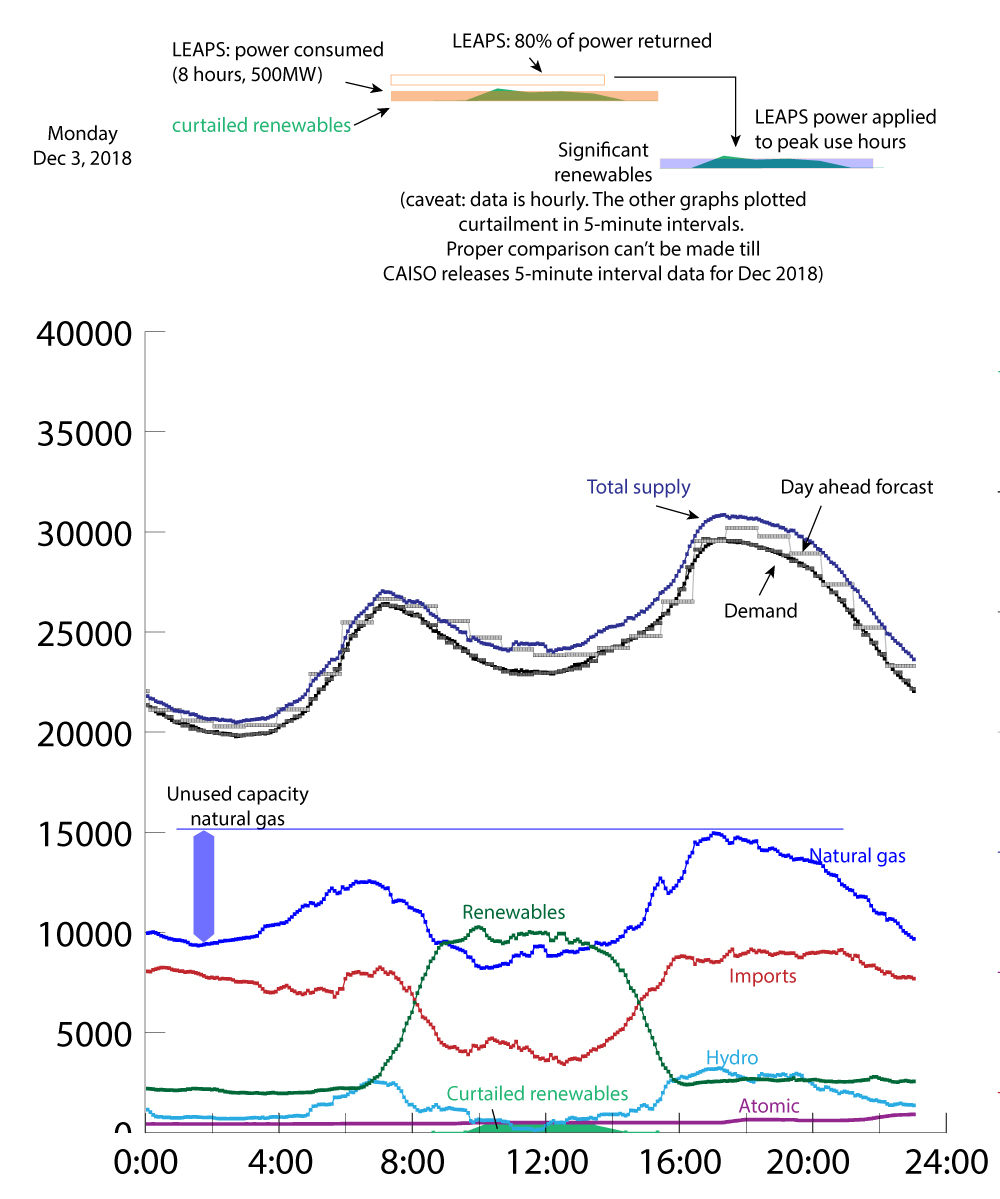
I looked at this as an actual day-to-day scenario using daily energy data for 2018 supplied by CAISO. I'm making a few assumptions. The plant would likely pump one day and deliver the next day or later or would pump intermittently over several days, but as a simple thought exercise, I'm looking at each day and asking how un-used (curtailed) power from renewable energy could be returned on a similar day to provide load balancing and do so when energy rates are highest for maximum profit (or should I say maximum recovery of losses). I also assume the plant needs to deliver power nearly every day to recover losses. Later I hope to compare this to actual energy supplier prices.

I created graphs for the first Monday of the months of May, June, July, Aug., Sept., and Oct. that compare hourly MW of energy production to demand and amount of wind and solar curtailed (unused). The graphs for April and Dec. have different data sources: April is for April 10, a Tuesday, because I couldn't find supply and demand data for April 2 in the same format. December uses curtailment data that is in hour intervals rather than 5-minutes intervals for the same reason.

Of these sample dates, only May 7, Nov. 5, and Dec 2 have enough curtailed renewables to be a noticeable part of the daily energy storage of LEAPS, making up about 1/2 the full capacity of LEAPs during midday and being returned in the afternoon. On June 4, most of the wasted renewables occurred during peak use hours, so this would be the most expensive time for a private consortium to fill the reservoir. On July 2, there is no significant renewables available, and Aug. 6 offers even less renewables and this continues through Oct. So, just on the banking renewables question for these days, LEAPS succeeds three halves out of nine, and so to operate at full capacity it would have to use another energy source if it were to fill its reservoir at non-peak hours.  I believe the most likely source will be natural gas and since LEAPS returns only 80% of the energy it uses, this makes the natural gas emissions greater by 20%.