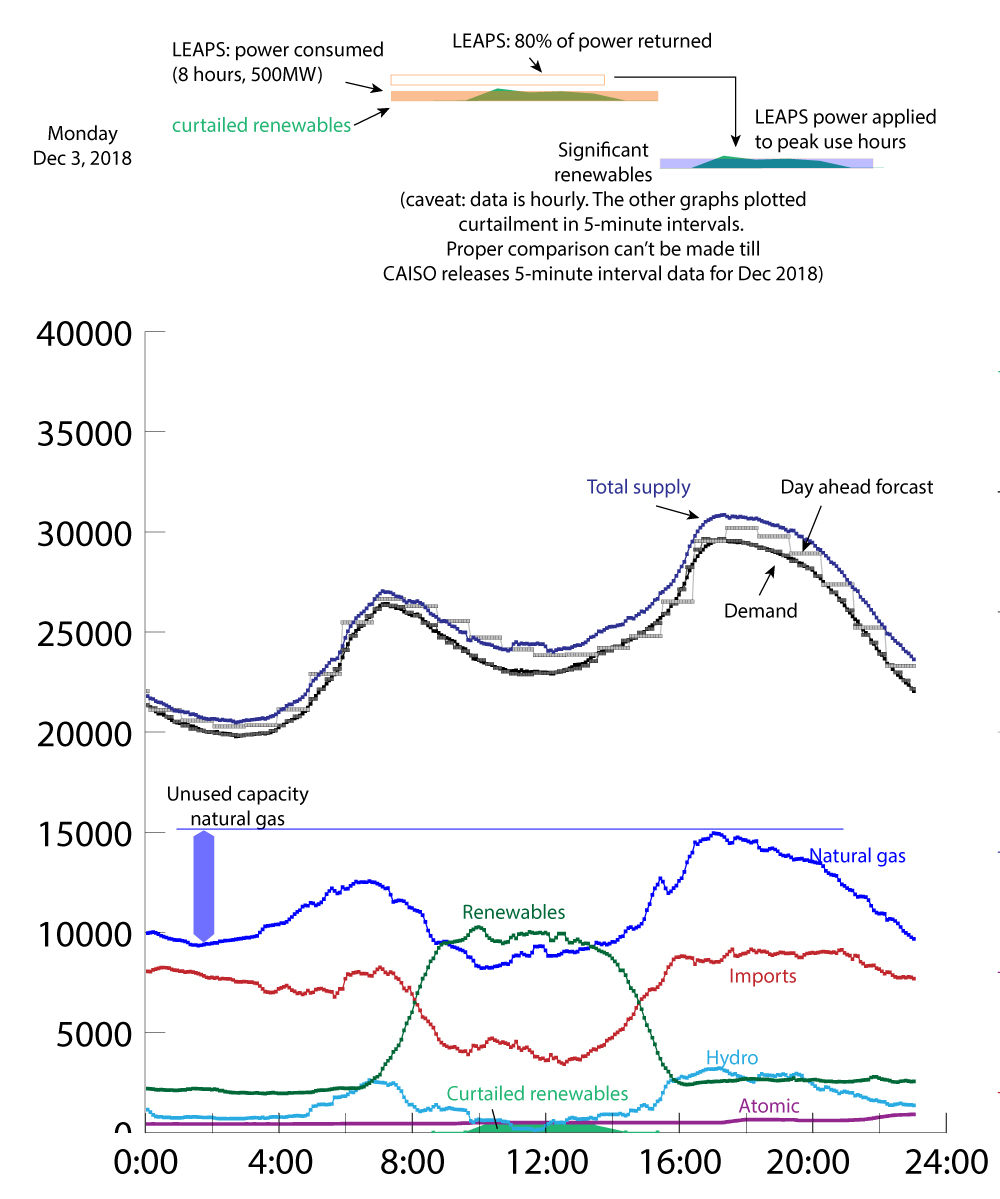
I've been looking at the relationship between storing renewables, load balancing, and making a profit. It should be noted that this pumped storage project is very expensive (at least 2 billion) and the proponents have told me in person that a private consortium will operate it (and therefore I infer it must make a profit; an alternative would be to sell it to the public as infrastructure, which I still believe to be plausible).
The plant (called LEAPS) will pump water from Lake Elsinore to a reservoir carved out of the Cleveland National Forest, storing electric energy, from the grid used to pump the water, as potential energy to be reclaimed by letting the water flow back through the turbines. 80% of the energy consumed is returned.
I looked at this as an actual day-to-day scenario using daily energy data for 2018 supplied by CAISO. I'm making a few assumptions. The plant would likely pump one day and deliver the next day or later or would pump intermittently over several days, but as a simple thought exercise, I'm looking at each day and asking how un-used (curtailed) power from renewable energy could be returned on a similar day to provide load balancing and do so when energy rates are highest for maximum profit (or should I say maximum recovery of losses). I also assume the plant needs to deliver power nearly every day to recover losses. Later I hope to compare this to actual energy supplier prices.
I created graphs for the first Monday of the months of May, June, July, Aug., Sept., and Oct. that compare hourly MW of energy production to demand and amount of wind and solar curtailed (unused). The graphs for April and Dec. have different data sources: April is for April 10, a Tuesday, because I couldn't find supply and demand data for April 2 in the same format. December uses curtailment data that is in hour intervals rather than 5-minutes intervals for the same reason.
Of these sample dates, only May 7, Nov. 5, and Dec 2 have enough curtailed renewables to be a noticeable part of the daily energy storage of LEAPS, making up about 1/2 the full capacity of LEAPs during midday and being returned in the afternoon. On June 4, most of the wasted renewables occurred during peak use hours, so this would be the most expensive time for a private consortium to fill the reservoir. On July 2, there is no significant renewables available, and Aug. 6 offers even less renewables and this continues through Oct. So, just on the banking renewables question for these days, LEAPS succeeds three halves out of nine, and so to operate at full capacity it would have to use another energy source if it were to fill its reservoir at non-peak hours. I believe the most likely source will be natural gas and since LEAPS returns only 80% of the energy it uses, this makes the natural gas emissions greater by 20%.